STEVEN SEINBERG: RELIQUARY
Foreword by Donovan Johnson
Absence is a weight we carry, even when we do not recognize its presence. It is the breath we feel in a room
emptied of its sound, the tension of an unspoken word, the silent imprint of something sacred, fragile, and
profoundly human. There are moments in the presence of Steven Seinberg’s work when the very room itself
seems to hold its breath. His paintings, drawings, and now his first-ever sculptures and installations possess a
gravitational pull that resists the noise of the outside world, urging a quiet, deliberate contemplation. They are
not about filling space but giving form to what remains—the unseen, the unspoken, the unresolved.
For Seinberg, absence is not a void but a presence, a force that shapes our experience of the material and
metaphysical. This inquiry has spanned over three decades of his practice, during which Johnson Lowe Gallery
(formerly Bill Lowe Gallery) has had the privilege of presenting seventeen exhibitions of his work. My
introduction to Seinberg’s practice came through the late Bill Lowe, whose tireless dedication to his vision built
the foundation of what the gallery has become. I have had the honor of curating two of these exhibitions, and
through this relationship, I’ve come to regard Steven not only as an incomprehensibly intuitive and brilliant mind
but also as a dear friend.
The formal prowess of Seinberg’s practice finds its roots in a lineage of abstractionists that includes Mark
Rothko, Cy Twombly, and Clyfford Still, artists whose work transcended aesthetic concerns to delve into the
depths of human emotion and spiritual inquiry. Rothko once spoke of his paintings as facilitating a “religious
experience,” and this idea of art as a pathway to transcendence is what I have come to discover as a
foundational touchstone of Seinberg’s ethos. But where Rothko’s color fields reach for the sublime in their
vastness, Seinberg’s work actualizes that sublimity through their embrace of an uncanny equilibrium, one that
reasserts the essential dualities inherent to existence itself.
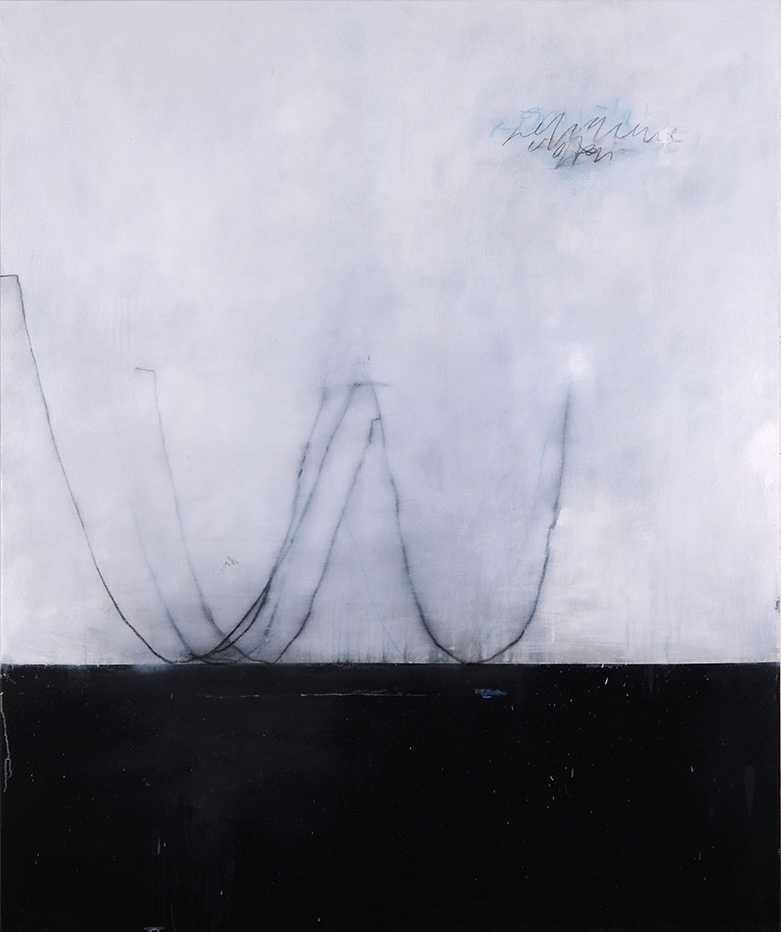
A turning point in Seinberg’s practice emerged in 2022 with the exhibition, The Third Book on Light and Shade.
Inspired by Leonardo da Vinci’s exploration of illumination and obscurity, Seinberg produced a series of starkly
bifurcated canvases that captured the thresholds between light and shadow. These works introduced a
profound engagement with duality—not as an oppositional force but as interdependent phenomena that define perception itself. In many ways, this body of work marked the construction of a world parallel to his earlier
paintings—a universe informed by the shadows cast by his visual lexicon.
Within The Third Book on Light and Shade, Seinberg developed a series of drawings that he refers to as “book
pages”—a series of intimate drawings that distill the principles of light and shadow into concentrated, reverential
studies. These works, layered with graphite, charcoal, and subtle washes of pigment, reflect da Vinci’s influence
while establishing an unmistakable connection to Seinberg’s own conceptual inquiries. The drawings capture a
sense of precision and depth that feels ancient yet immediate, as though each line carries the weight of
centuries of philosophical reflection.
As Seinberg’s practice evolved into the series for which this catalog is dedicated, Reliquary (2023–2024), a body
of work created between 2023 and 2024, the artist began to extend and deepen these explorations,
transforming the stark contrasts of his “light and shade” canvases into something more intricate, more resonant.
Where The Third Book on Light and Shade charted the terrain of light and shade as elemental phenomena, Reliquary inhabits the spaces between—moments where presence and absence, materiality and impermanence,
converge into a singular, charged equilibrium. Vessel-like forms began to emerge in his drawings, most notably
in works on paper like Collected, Not Found (2024), where fine graphite lines and subtle tonal gradations create
shapes that evoke the idea of holding—light, memory, and the intangible. These forms, which were introduced
in the drawings, became central to the larger paintings, reinforcing the idea that Seinberg’s drawings serve as
the conceptual and formal foundation of his broader practice. He describes these drawings as akin to haikus,
distilling complex ideas into concise, evocative gestures.
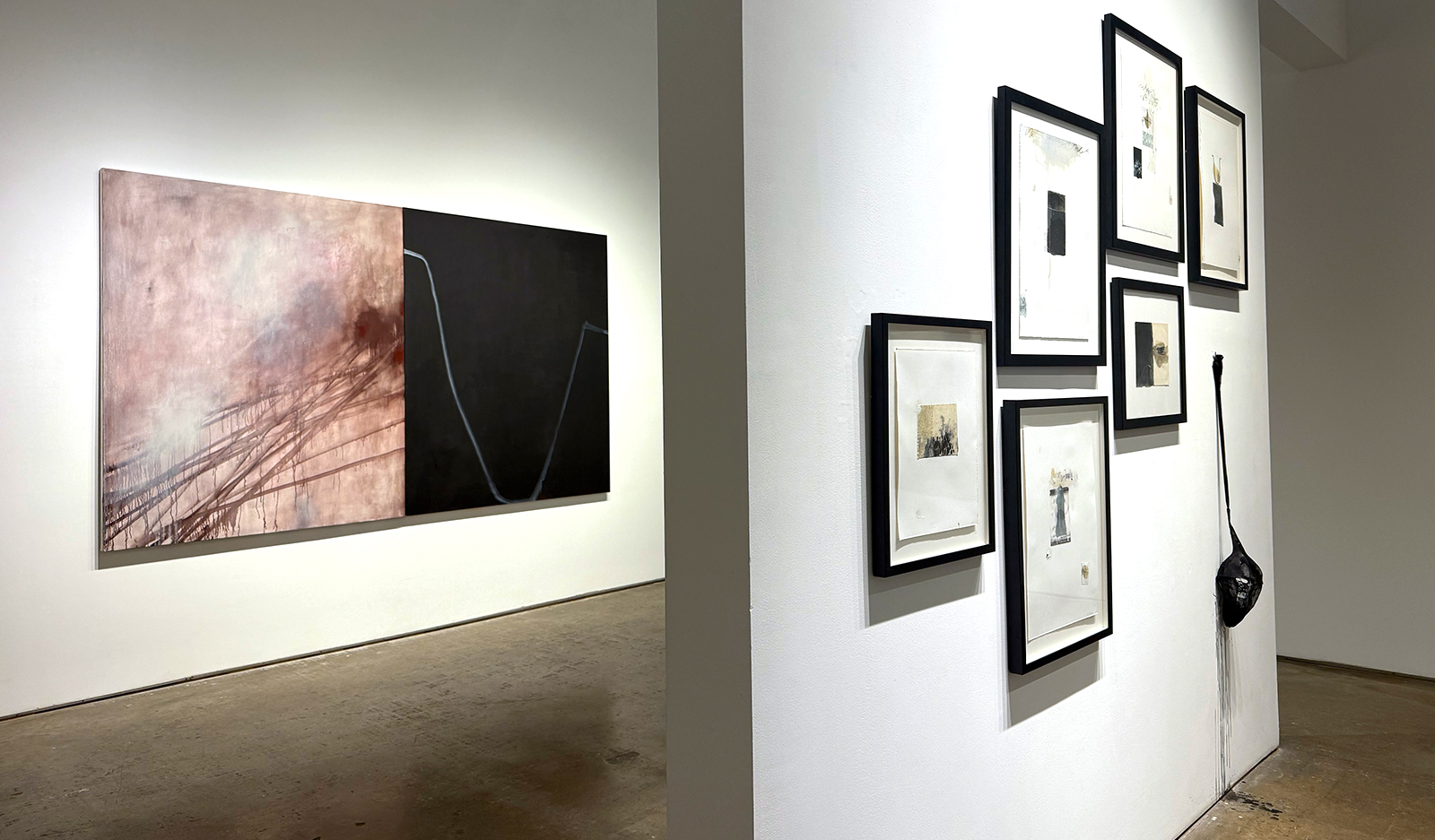
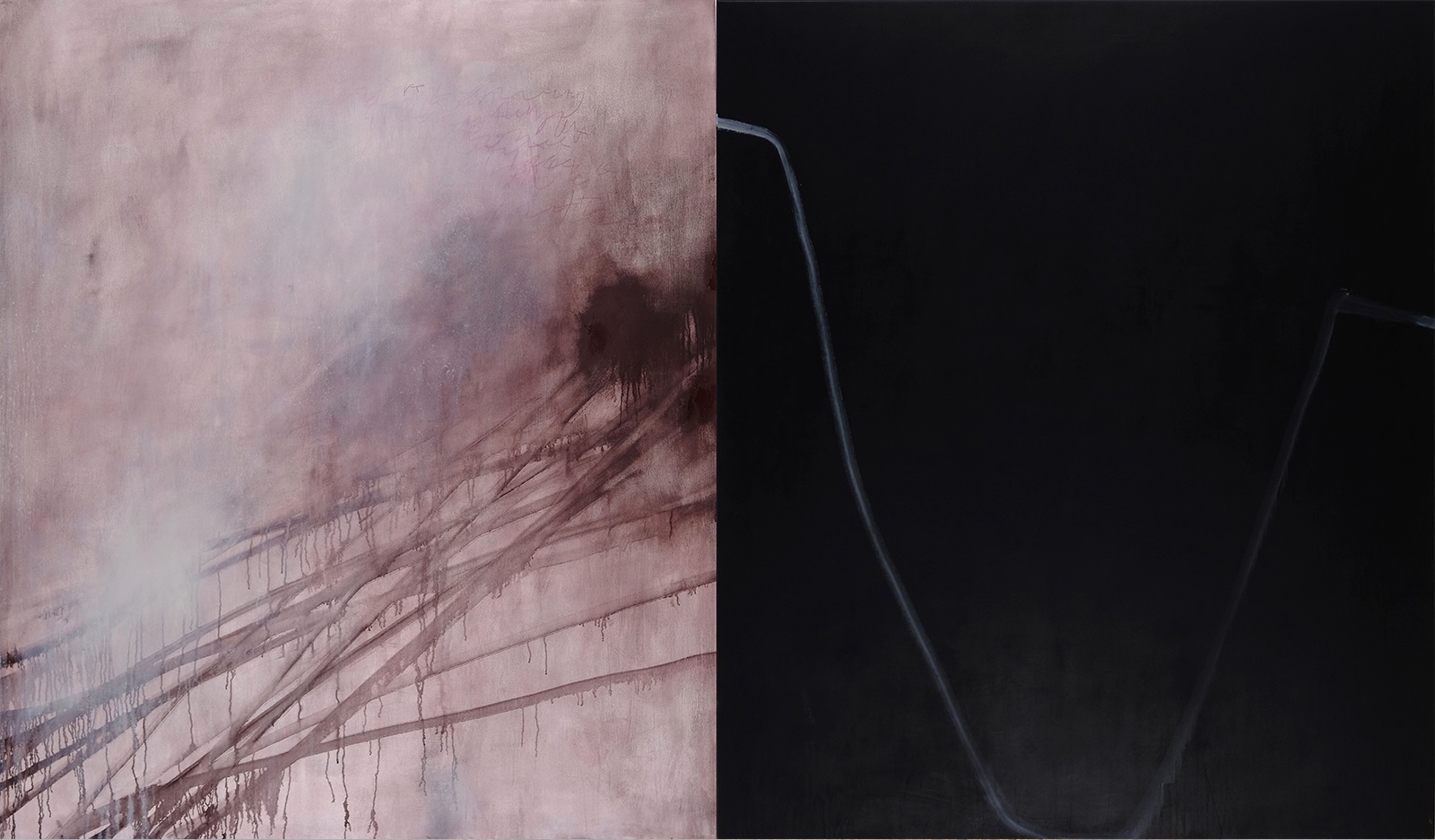
In the larger paintings, such as “Reliquary,” Seinberg constructs compositions that feel both expansive and
intimate. This seventy-by-one-hundred-twenty-inch canvas balances contrasting panels: the left, a layered field
of bruised mauve, smoky lilac, and ash-gray, hums with quiet dynamism, while the right, a plane of matte black,
holds its weight in a singular, sinuous line that arcs across its surface. The tension between these panels is not
oppositional but symbiotic, each reinforcing the presence of the other. The painting itself becomes a vessel—a
reliquary for what cannot be spoken but only felt.
During his time in Portugal, Seinberg encountered medieval and Renaissance reliquaries—ornate vessels
designed to hold fragments of saints and bridge the physical and divine. These objects deeply influenced his
work, providing both a conceptual and formal framework for Reliquary. The idea of a reliquary as both a
container and a conduit resonates throughout the series, not only in the sculptures but also in the paintings and drawings, where vessel-like forms take on new, symbolic meaning. These works, like the reliquaries that inspired
them, function as thresholds—spaces where the material and the ineffable converge.
For the first time in his three-decade-long career, Steven Seinberg has introduced sculpture into his practice, a
development that both complements and expands his language. These objects, some found and transformed
by the artist’s hand, like Reliquary X and Reliquary I, are composed of reclaimed wood from furniture belonging
to his grandparents’ Brooklyn home, infusing them with personal history and memory. The use of these
fragments—teeming with the presence of a life lived—creates a sense of intimacy that anchors the sculptures in
the same spirit as the reliquaries the artist discovered throughout his travels and echo the containment and
transformation that pervade his drawings and paintings. They are at once protectors of what is contained and
objects of contemplation themselves, evoking a tension between fragility and permanence, absence and
presence.
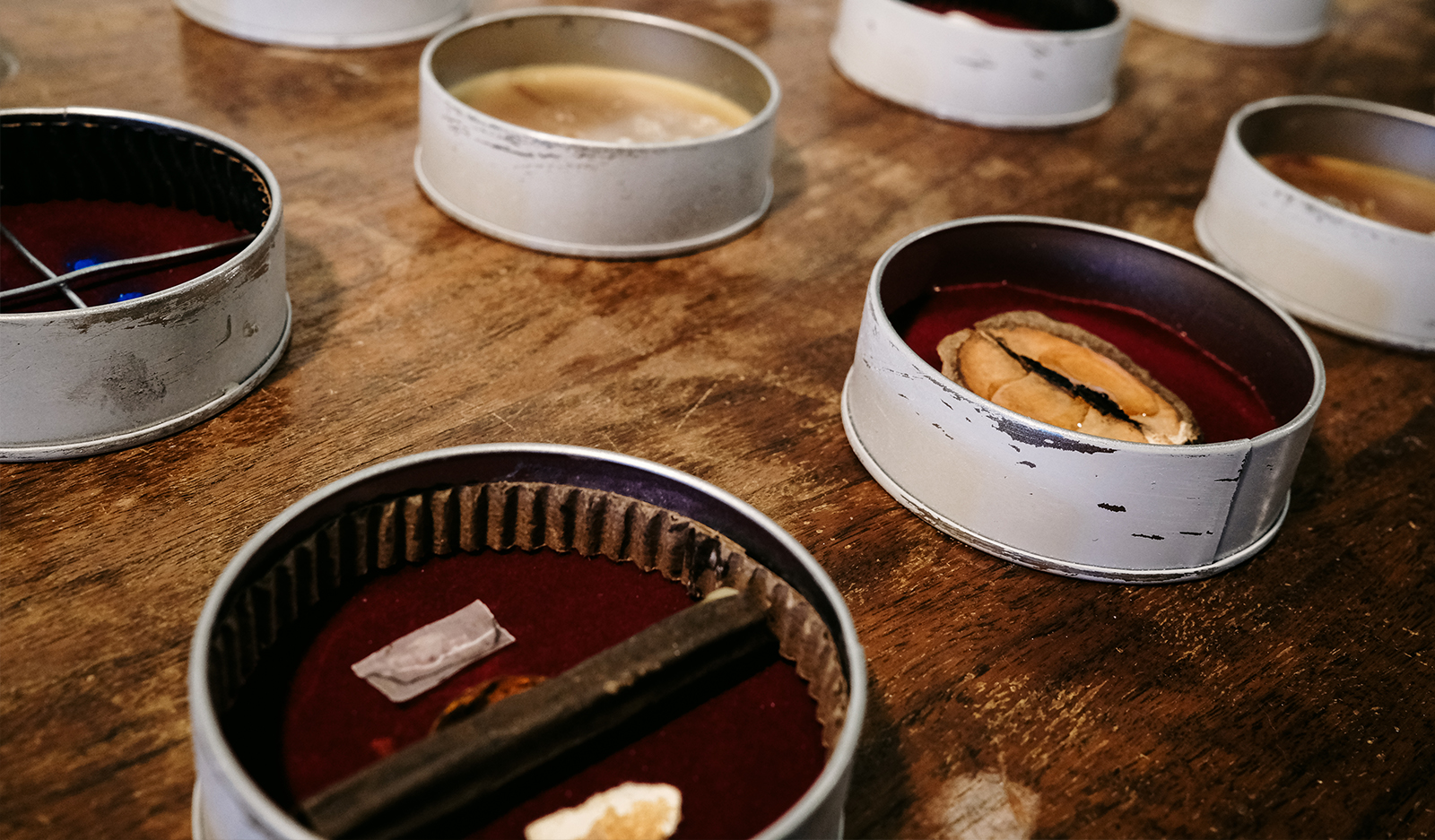
The smaller studio reliquaries, meanwhile, are collections of collaged elements and items gathered over time—
materials that had been scattered and now find themselves contained within these sculptural forms. These
objects feel like intimate archives, each an accumulation of fragments transformed through Seinberg’s process
into cohesive entities. They do not function as preparatory studies for the larger works but instead emerge
directly from the same conceptual space as his drawings and paintings. There is a palpable sense that these
sculptures are not separate from the other works in the exhibition but are inextricably linked, as though they
have materialized from within the painted surfaces themselves. These works, like the reliquaries that inspired
them, function as thresholds—spaces where the material and the ineffable converge.
In my observations of Seinberg’s practice—particularly the developments that define this series—I found myself
reflecting on how, as we age and gain wisdom, we often find ourselves reflecting on our lives with a profundity
that allows us to become acutely aware and objectively conscious of truths we could intuit but not yet fully
articulate. This is where Reliquary resides—in that space of deepened understanding, where the interdependent
forces of existence are not only observed but honored, and where balance becomes not just a principle but a
practice. These are phenomenological encounters, works that stand still with the weight of what is both there
and not, revealing that the spaces between are where meaning takes root.
Seinberg’s engagement with spirituality has always been embedded in his practice, though its expressions have
evolved. While nondualism offers one lens through which his work can be interpreted, it is but one entry point
into a broader language that traverses the material and metaphysical. His works, informed by traditions that
span cultures and ages, reflect a deep awareness of the universal truths that bind us.
Donovan Johnson
Atlanta
December 2024